
Quick summary:
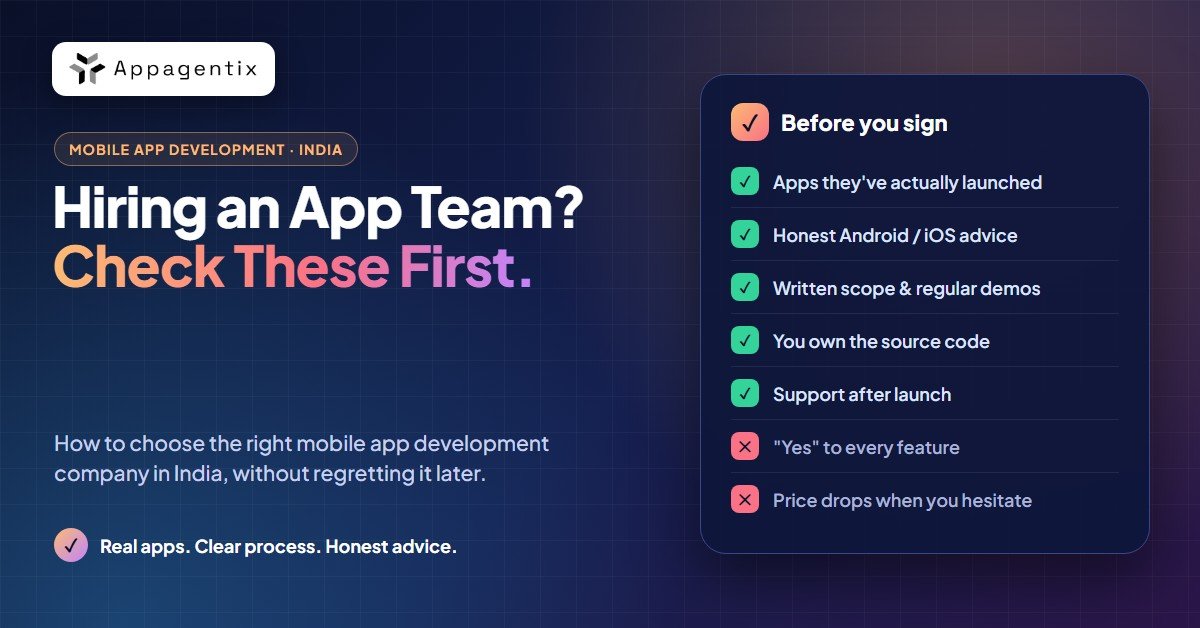
- The right partner matters more than the lowest quote. A cheap build that fails costs more than a fair one that works.
- Look at real apps they've shipped, not just their website and pitch deck.
- Ask how they handle Android, iOS and cross-platform choices, and why.
- Clear communication, written scope and regular demos are signs of a reliable team.
- Check who owns the code, how testing works and what happens after launch.
At Appagentix AI Solutions, we often talk to founders who are looking for a mobile app development company in India, and many of them have already been burned once. The story usually sounds the same: a low quote, a quick yes to every feature, and six months later an app that crashes, a team that stopped replying, and a budget that's gone.
It doesn't have to go that way.
India has some of the best mobile app talent in the world. The challenge is telling the solid teams apart from the ones that only look good in a sales call. Here's what to check before you sign anything.
Why Does Choosing the Right App Development Partner Matter So Much?
Your app is often the first thing customers touch. If it's slow or confusing, they won't give it a second chance.
A good partner questions unclear ideas and warns you about problems before they get expensive. A weak one just builds whatever you say. That sounds convenient. It rarely is.
What Should You Look for in a Mobile App Development Company in India?
1. Real apps, not just a nice website
Any team can build an impressive website. Ask to see apps they've actually built and launched.
Download them and use them for ten minutes. Are they fast? Do the screens make sense? An app that hasn't been updated in two years tells you something.
2. Honest advice on platforms
A good team won't push one technology for every project. Ask them directly:
- Should we build native Android and iOS apps, or go cross-platform?
- Would Flutter or React Native suit our app better, and why?
- Which platform should we launch first for our users?
If they give the same answer to every client, that's a red flag. The right answer depends on your users, budget and features.
3. A process you can actually follow
You should always know what's happening with your project. Ask how they work week to week.
Strong teams usually share:
- A written scope before work starts
- Short development cycles with regular demos
- One clear point of contact
- A shared tool where you can track progress
If the plan sounds like "we'll show you everything at the end," walk away.
4. Design that's tested, not just pretty
Beautiful screens mean nothing if users can't figure out where to tap. Ask whether they test designs with real users or at least with clickable prototypes before development begins.
Fixing a confusing screen in a design file takes an hour. Fixing it after it's built can take a week.
How Do You Know If a Quote Is Fair?
Quotes for the same app can vary a lot across India. A very low number usually means something is missing.
Check what's included:
- UI/UX design or only development?
- Backend, admin panel and APIs?
- Testing on real devices?
- App Store and Google Play publishing?
- Bug fixes after launch?
Ask for a breakdown by feature or phase. A team that can explain where every part of the budget goes usually knows what it's doing.
It also helps to start smaller. A focused first version, or MVP, lets you test the idea and the team before committing to a full build.
Which Questions Should You Ask Before Signing?
Keep this list handy for your first few calls:
- Who owns the source code and design files once the project is done?
- Will the same developers stay on my project from start to finish?
- How do you test the app, and on which devices?
- How do you handle changes to scope midway?
- What does support look like after launch, and what does it cost?
- Can I speak to one or two past clients?
Pay attention to how they answer, not just what they say. Clear, direct answers are a good sign. Vague promises are not.
What Are the Biggest Red Flags?
- They agree to everything. No pushback on unrealistic timelines or features.
- No written scope. Everything stays verbal.
- The price drops sharply when you hesitate. That usually means corners will be cut.
- You can't reach the actual developers. Only sales people answer.
- Code ownership is unclear. Always get this in writing.
Does Experience With Your Industry Matter?
It helps, but it isn't everything. A team that has built fintech apps already understands security and compliance; one that has built delivery apps knows real-time tracking.
Still, strong mobile app development fundamentals matter more than a perfect industry match. Good teams learn your business quickly by asking the right questions.
What Happens After the App Goes Live?
Launch is not the finish line. Real users will find bugs, request features and use your app in ways you never expected.
Before signing, make sure the team offers:
- Bug fixes for a set period after launch
- Updates for new Android and iOS versions
- Performance monitoring and crash reports
- A simple way to add new features later
If you plan to add AI features or custom integrations down the line, ask whether they can support that too, so you don't need to switch teams later.
Frequently Asked Questions
1. Is it safe to hire a mobile app development company in India for a foreign business? Yes. Many Indian teams work with clients in the US, UK, Middle East and Australia. Clear contracts, regular calls and overlapping working hours make it smooth.
2. Should I choose a freelancer or a company? Freelancers suit small, simple apps. For apps that need design, backend, testing and long-term support, a company is usually more reliable.
3. How long does it take to build a mobile app? It depends on features and complexity. A focused first version takes far less time than a full product with many integrations.
4. Should I build for Android or iOS first? Look at where your users are. In India, Android usually comes first. For a mixed audience, cross-platform development lets you launch on both.
5. Who should own the app's source code? You should. Make sure the contract clearly transfers code and design ownership to you.
6. Can I start small and grow the app later? Yes, and it's often the smartest approach. Launch the core features first, learn from users, then expand.
Conclusion
Choosing a mobile app development company in India is less about finding the cheapest quote and more about finding a team you can trust with your idea. Look at real work, ask direct questions and insist on a clear process.
At Appagentix AI Solutions, we build Android, iOS and cross-platform apps for startups and growing businesses, and we're always happy to talk through your idea honestly, even if that means suggesting a simpler first version.